
India is the world's second-largest cement producer. We manufacture over 375 million tonnes annually, supply a $25 billion construction industry, and are the backbone of every infrastructure project from highways to housing. Yet the logistics layer that moves this cement — from plant to dealer to project site — remains largely invisible.
That invisibility is costing the industry dearly.
The Scale of the Problem
When a cement truck leaves a plant gate, manufacturers typically know two things: the truck number and the declared destination. What happens between dispatch and delivery is, for most companies, a black box.
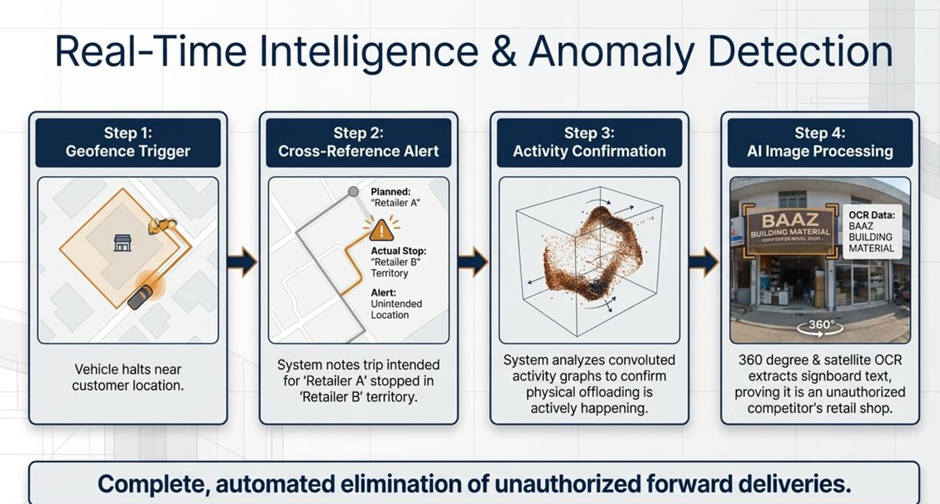
This gap has created fertile ground for grey market diversion — where cement dispatched to one dealer is partially or fully offloaded at an unauthorized point and resold outside the manufacturer's distribution network. Industry estimates suggest grey market leakage costs Indian cement manufacturers between 5–12% of annual distribution revenue. For a mid-sized manufacturer moving 10 million tonnes a year, that is not a rounding error. It is a structural revenue drain running into hundreds of crores.
Beyond diversion, there are subtler but equally costly problems: back unloading (cement offloaded at a roadside point before the dealer), short delivery (trucks arriving with less cement than dispatched), and detention — trucks waiting hours at plant gates or dealer points, clocking idle costs the manufacturer ultimately absorbs.
The industry has accepted these losses as a cost of doing business. The assumption has been that tracking cement trucks is too complex — too many transporters, too much geography, too little compliance infrastructure. That assumption is outdated.
What Modern Logistics Visibility Actually Looks Like
The breakthrough in cement logistics visibility isn't GPS. GPS alone tells you where a truck is. It doesn't tell you whether it stopped at an unauthorized point, whether cement was unloaded mid-route, or whether the truck actually delivered to the right dealer.
What cement companies need is a logistics control tower — a unified intelligence layer that combines location data with behavioural signals to answer the questions that matter: Did this truck stop somewhere it shouldn't have? Was cement unloaded before the dealer point? Did the truck linger at a suspicious location long enough to offload a partial load?
This is where activity sensing changes the equation. Unlike passive GPS tracking, activity sensing uses sensor data and AI-based algorithms to detect whether a truck is actively unloading or simply stopped in traffic. Combined with geofencing at dealer points and halt-pattern analysis, it becomes possible to detect back unloading and short delivery events automatically — without relying on manual reporting from drivers or dealers.
The ETA Problem Is Just as Expensive
Grey market gets the headlines, but ETA failure is a quieter drain that affects every plant every day.
When a cement truck's estimated arrival is wrong by 4–6 hours, dealers run out of stock, construction sites stall, and manufacturers field complaint calls they have no data to respond to. The problem compounds at the plant end: without accurate ETAs on returning trucks, dispatch planning becomes guesswork and loading queues build up, wasting driver time and plant capacity.
Accurate ETA prediction for cement truck logistics requires more than a map API. It needs real-time traffic on Indian highways, historical halt patterns by route and transporter, and the ability to recalculate dynamically when trucks deviate. The difference between a distance-based ETA estimate and an AI-driven one can be measured in dealer satisfaction scores and fleet utilisation rates.
What This Means for Indian Cement Manufacturers
The companies that will win on distribution margins over the next five years won't necessarily be the ones with the largest fleets or the lowest freight rates. They will be the ones with the most accurate picture of what their trucks are actually doing.
Real-time visibility into plant-to-dealer movement — with automatic alerts for suspicious halts, diversion events, and delivery anomalies — is no longer a technology experiment. It is becoming a competitive baseline.
Indian cement manufacturers are beginning to recognise this. The question is no longer whether to invest in logistics intelligence, but how quickly to move — and which infrastructure to build on.
The logistics blind spot that has cost this industry thousands of crores is, for the first time, genuinely solvable.
Mrinal Rai is Co-founder of Intugine Technologies, a supply chain visibility platform serving India's cement, freight, and manufacturing sectors.