
Transforming waste into valuable resources is no longer a conceptual aspiration but a practical reality at the Rajiv Gandhi Institute of Petroleum Technology (RGIPT). The institute has emerged as a pioneering model for integrated waste management and circular economy implementation, where multiple waste streams are systematically converted into energy, materials, and reusable resources. This transformation has been driven by the vision and leadership of Prof. Harish Hirani, whose extensive experience in sustainable technologies and large-scale waste management has enabled the development of a campus-wide, practice-oriented ecosystem. Building upon his earlier contributions at CSIR-CMERI, the initiatives at RGIPT demonstrate how academic institutions can evolve into living laboratories, seamlessly integrating research, technology deployment, and real-world applications in sustainability.
A central pillar of this transformation is the development of an integrated zero-waste ecosystem at RGIPT, designed around a closed-loop resource recovery approach. Unlike conventional waste management practices that treat waste streams in isolation, the RGIPT model interconnects multiple streams to maximize resource efficiency and minimize environmental impact. Wastewater generated on campus is treated through a sewage treatment system and reused for non-potable applications, including aquaculture, thereby creating a sustainable water cycle. Organic waste is processed through anaerobic digestion to generate biogas, contributing to renewable energy production. At the same time, plastic waste is systematically repurposed into functional and durable products, reducing landfill dependency and environmental burden. Together, these interventions demonstrate a practical and scalable framework for transitioning towards a circular and resource-efficient campus.
In addition to core waste-to-resource pathways, RGIPT has incorporated advanced technologies such as biochar production and membrane-based treatment systems to enhance both carbon management and water purification. These innovations enable carbon capture through biochar applications and improve the efficiency of wastewater treatment, adding a climate-responsive dimension to the overall waste management strategy. By integrating such emerging technologies, the system extends beyond conventional waste handling to address broader environmental challenges, including emissions reduction and resource conservation.
The broader objective is to position RGIPT as a model institution for circular economy implementation, where waste is consistently treated as a valuable resource and reintegrated into productive use with minimal environmental impact. This approach uniquely combines research, technology deployment, and institutional practices, effectively bridging the gap between laboratory innovation and real-world application. It demonstrates how academic campuses can function as scalable testbeds for sustainable solutions with national relevance.
Looking ahead, the focus at RGIPT is on scaling and optimizing the integrated zero-waste systems to achieve a fully self-sustained campus. This includes expanding waste-to-energy pathways, strengthening advanced material recovery processes, enhancing water reuse networks, and incorporating efficient carbon management technologies. The objective is to improve system efficiency, increase resource recovery, and develop a robust, self-reliant model that can be replicated across other institutions and urban settings.
These efforts will culminate in the observance of International Zero Waste Day on 30th March, during which the institute will showcase its integrated waste management technologies. The occasion will serve as a platform to demonstrate RGIPT’s commitment to sustainable practices and circular economy principles through live demonstrations of its campus-scale systems, highlighting their potential for broader societal adoption.
The technological framework at RGIPT is grounded in the principles of a circular bioeconomy, wherein waste streams are systematically interconnected to enable continuous resource recovery. Rather than treating waste in isolated silos, the approach links energy, water, materials, and nutrient cycles into a unified system. This integrated model ensures that outputs from one process serve as inputs for another, thereby maximizing efficiency and minimizing environmental losses. By embedding such interdependencies, the framework establishes a self-sustaining pathway for waste utilization while contributing to long-term ecological balance and resource conservation.
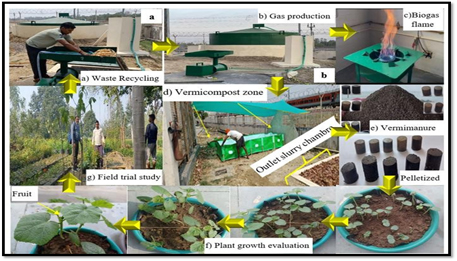
At the core of this framework is the circular bioeconomy system that links organic waste management with energy generation and agricultural applications. Organic and food waste generated on campus are processed through anaerobic digestion to produce biogas, serving as a renewable energy source. The residual digestate is further converted into value-added products such as vermicompost, pelletized manure, and nutrient-rich soil conditioners. These outputs are utilized in agricultural applications, enhancing soil fertility and supporting sustainable crop production. This integrated pathway not only ensures efficient utilization of organic waste but also closes the nutrient loop, reducing dependence on external inputs and promoting a more resilient and sustainable ecosystem.
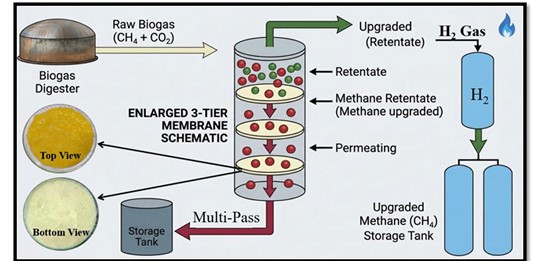
A key challenge in biogas utilization is the presence of carbon dioxide (CO₂) and other impurities, which reduce its calorific value and overall efficiency. To address this, RGIPT has developed a membrane-based biogas upgrading system enhanced with nanofluid-assisted separation. In this multi-stage configuration, CO₂ and trace impurities are selectively removed while methane is retained and enriched. The incorporation of nanofluids improves mass transfer and separation efficiency, and a multi-pass operation further enhances methane concentration. As a result, the upgraded biomethane exhibits significantly higher energy content and improved fuel quality. This approach represents a notable advancement over conventional purification techniques, while also contributing to carbon capture and making the process both energy-efficient and environmentally responsive.
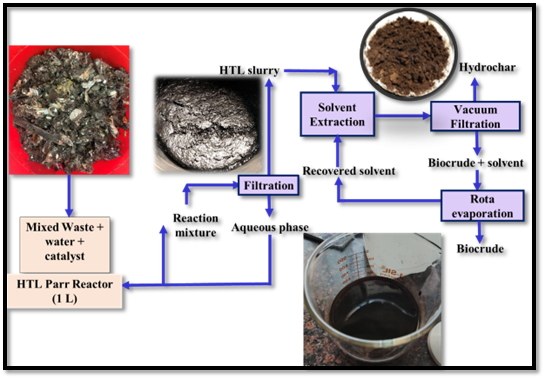
To further strengthen the waste-to-energy pathway, RGIPT has adopted hydrothermal liquefaction (HTL) as an effective solution for converting mixed and low-value waste streams into useful fuels. This technology is particularly relevant in the current waste management landscape, where heterogeneous waste—especially combinations of plastic and organic matter—poses significant recycling challenges and often ends up in landfills or incineration systems. Under optimized conditions of elevated temperature and pressure, HTL converts such mixed waste into biocrude oil, along with hydrochar and gaseous byproducts. The process yields approximately 10 wt.% biocrude, demonstrating its potential as an alternative energy source. By enabling the recovery of energy from otherwise non-recyclable waste, HTL offers a sustainable and practical pathway to reduce landfill dependency while contributing to resource efficiency and circular economy goals.
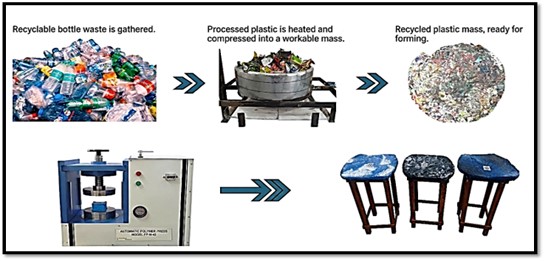
Material recovery within the framework is further strengthened through plastic waste valorization, wherein non-recyclable plastic is transformed into durable and functional utility products. Through controlled thermal and mechanical processing, discarded plastics are converted into items such as mats, tables, and stools that exhibit good strength, durability, and resistance to environmental conditions. This approach not only addresses the challenge of plastic waste disposal but also generates economically useful materials with practical applications on campus and beyond. By demonstrating a cost-effective and decentralized model, this initiative offers a scalable solution for plastic waste management, particularly relevant for urban and semi-urban settings where conventional recycling infrastructure is limited.
Water sustainability within the framework is achieved through an integrated nano–bio wastewater treatment system that combines biological processes with nanofluid-assisted interactions and plant-based extracts. This hybrid approach enables efficient removal of pollutants, including turbidity, dissolved solids, and organic contaminants, achieving reductions of over 95% in COD and BOD levels.
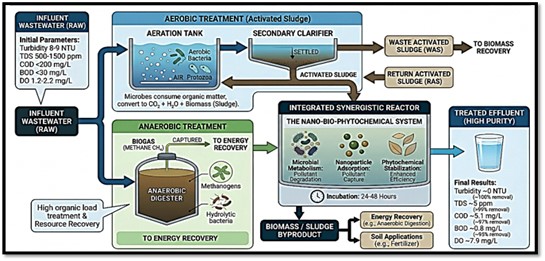
The treated water is suitable for reuse in irrigation, aquaculture, and other non-potable campus applications, thereby significantly reducing freshwater demand. In addition, the biomass generated during treatment can be further utilized for energy recovery or soil applications, ensuring minimal waste generation. This system demonstrates an effective and resource-efficient solution for closing the water loop within a sustainable campus ecosystem.
Collectively, these interventions form a cohesive and synergistic ecosystem in which each process contributes to the overall efficiency of the system. What distinguishes this model is not merely the deployment of individual technologies, but their seamless integration into a unified resource recovery network. Organic waste is converted into energy and soil nutrients, biogas is upgraded into a high-quality fuel, mixed waste is transformed into liquid and solid energy carriers, plastic waste is repurposed into functional products, and wastewater is treated for reuse. This interconnected approach ensures optimal utilization of resources across multiple domains while minimizing environmental impact. As the system continues to evolve, ongoing efforts are directed toward improving process efficiencies, expanding recovery pathways, and strengthening linkages between energy, water, and material cycles to achieve greater levels of self-sufficiency.
In summary, the integrated framework developed at RGIPT demonstrates a coherent and scalable pathway for transforming waste into valuable resources through scientifically designed and interconnected processes. By converting waste streams into energy, materials, and reusable inputs, the model not only addresses waste management challenges but also contributes to climate action, resource conservation, and sustainable development. Its strength lies in its practical implementation and replicability, offering a blueprint for other academic institutions, urban communities, and policy initiatives aiming to transition toward circular and resilient systems. As environmental pressures continue to intensify, such integrated and technology-driven approaches will play a crucial role in shaping sustainable futures.
Web Link for more information about the Program: https://rgipt.ac.in/IDZW-2026/

Prof. Harish Hirani
Director, RGIPT.
